The problem
Product information, customization logic, SKU structures, and sales education were difficult to navigate across audiences, limiting order confidence and made-to-order discovery.
The engagement
I owned the catalog across product data, information architecture, design, pricing editions, sales education, and field feedback. The work began by examining where product complexity blocked confident ordering, then repositioned the catalog as the shared operating interface between the ERP, internal teams, retailers, and customers.
The solution
I created one annual catalog system that turns a governed product model into complete and stock-focused editions, customer-specific pricing variants, SKU learning tools, and sales training. The design makes stock and made-to-order paths visible together so customization can be understood rather than discovered through exception handling.
1. Treat the catalog as a product-information system
The work starts with product truth, configuration logic, SKU structure, and pricing rules rather than page design. This makes the catalog accountable to the same operational model used for ordering and prevents presentation choices from obscuring how products can actually be sold.
2. Build several editions from one product model
A 72-page complete catalog and a 60-page stock catalog serve different buying contexts, while four pricing editions support customer types. The outputs change emphasis and commercial detail without creating separate interpretations of the underlying product line.
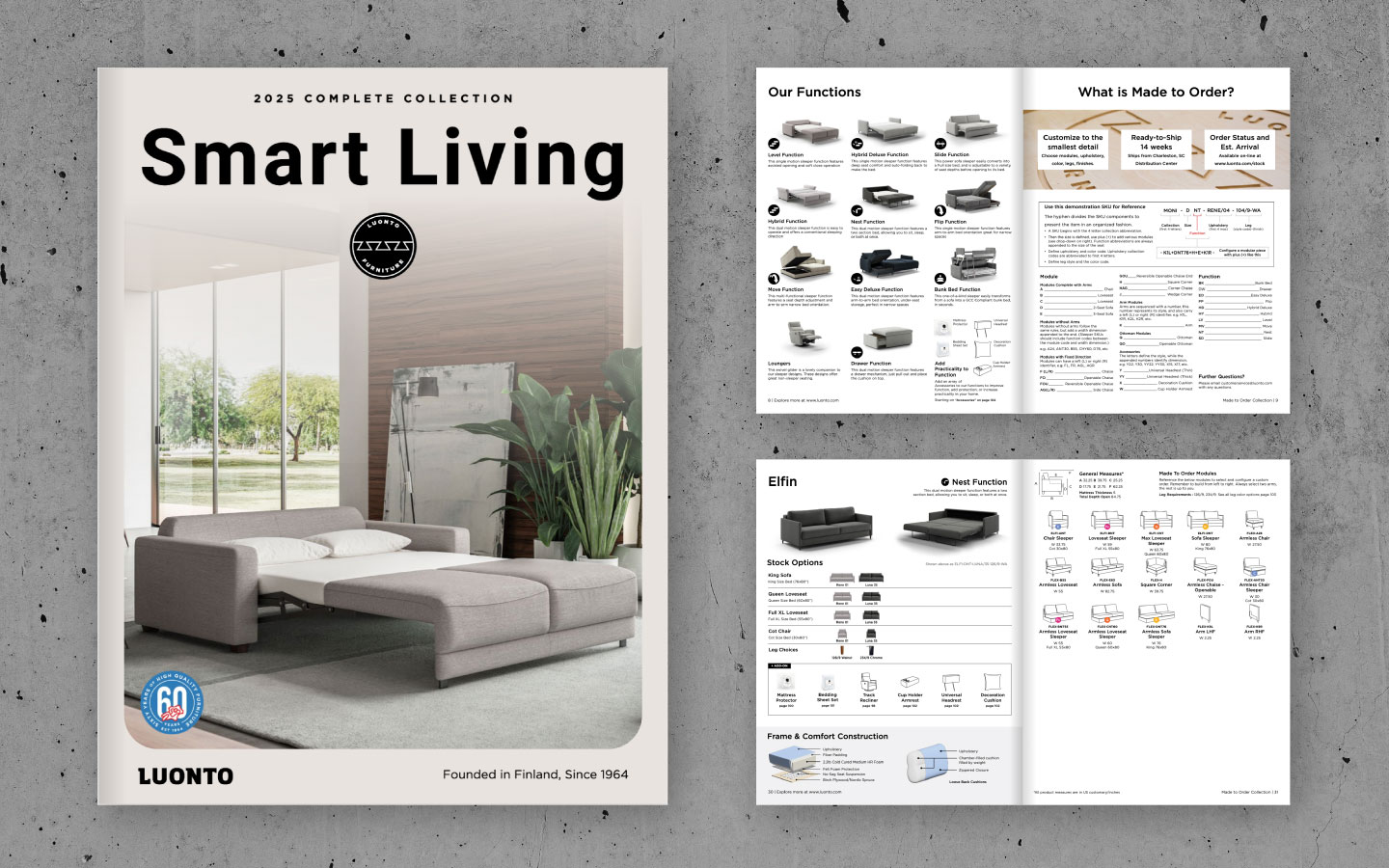
Complete, stock-focused, and pricing-specific editions are produced from the same governed product model. 3. Design for learning as well as reference
Side-by-side stock and made-to-order options, simplified tables, clearer hierarchy, and SKU learning tools help representatives understand the product logic they are expected to sell. The catalog supports onboarding and daily decision-making, not only lookup at the point of order.
4. Make feedback part of the annual cycle
Sales questions, retailer friction, customer behavior, and ERP changes are gathered as inputs to the next edition. The catalog improves as an operating system because field use informs the structure, training, and product explanations that follow.
Why it worked
The catalog aligned product truth with the way each audience makes decisions. One governed model preserved consistency, while audience-specific editions reduced irrelevant complexity. Connecting the artifact to training and feedback made it a living part of the commercial operation rather than an annual publishing event.
Outcomes
- Made-to-order sales increased by 3.5 percent.
- A 72-page complete catalog and a 60-page stock catalog support distinct buying contexts.
- Four pricing editions serve customer types without fragmenting the product model.
- Sales teams and retailers gained clearer SKU guidance and stronger visibility into customization options.
Owned the information system, annual catalog production, enablement, and training.